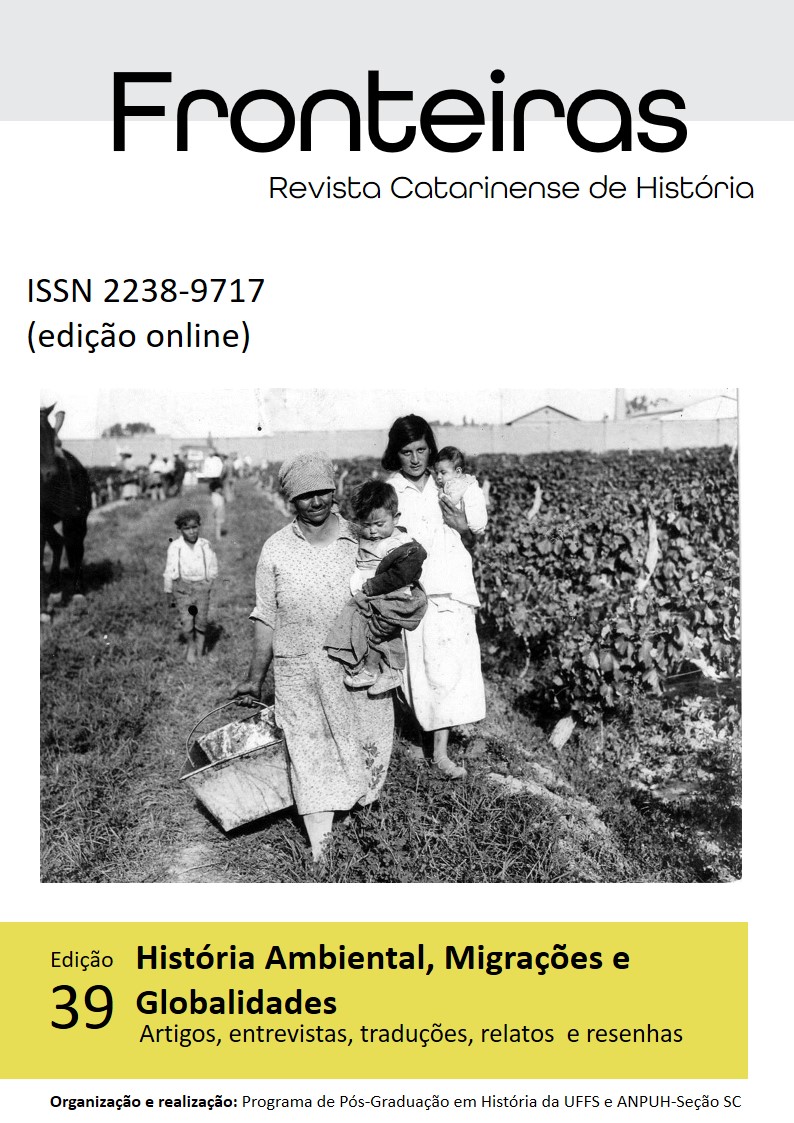
German migration, imperial science, and the translation/colonization of local ecologies of the subtropical climate in South America
DOI:
https://doi.org/10.29327/253484.1.39-6Keywords:
German migration, Climate, Subtropical, ClimatologyAbstract
This paper discusses the emergence of the subtropical climate in South America under the imperial and technological perspectives of German and Habsburg climatology and its intertwinements with German colonization in the region between the 19th and 20th centuries. German and Habsburg empires encouraged scholars to construct scientific climatology in order to address imperial agendas within their domains or wherever they had some degree of influence. Southern South America became since then a hotspot for climate research, since imperial interests expanded towards the Cono Sur region especially through German forest colonization. This study assumes that rather than being a naturalized climatologic notion, the subtropical converged into an array of possibilities for global empire building, the perspectivation of which contributed to the emergence of the climatological concept. The idea of the subtropical in South America entailed and confirmed racial, social and environmental inequalities and grounded the ulterior development of the region. In an attempt to decenter Eurocentric narratives, the intention of the paper is to set the subtropical into a global arena of determination by emphasizing the colonial instances of climate colonization and thereby bringing on contested climatic geographies.
Downloads
References
ARMIERO, M.; TUCKER, R. Migrants in Environmental History. In: Armiero, M.; Tucker, R. (Org.). Environmental History of Modern Migrations: Taylor & Francis, 2017, p. 1–16.
ARNOLD, D. J.; SIVARAMAKRISHNAN, K. The Tropics and the Traveling Gaze: India, Landscape, and Science, 1800-1856. Washington, D.C: University of Washington Press, 2015.
BALDWIN, Andrew; FRÖHLICH, Christiane; ROTHE, Delf. From climate migration to anthropocene mobilities: shifting the debate. Mobilities, v. 14, n. 3, p. 289–297, 2019.
BEATTIE, James; O'GORMAN, Emily; HENRY, Matthew. Climate, science and colonization: Histories from Australia and New Zealand. In: BEATTIE, J.; HENRY, M.; O'GORMAN, E. (Org.). Climate, science, and colonization: Histories from Australia and New Zealand, New York, NY: Palgrave Macmillan, 2014, p. 22–40.
BELDA, M.; HOLTANOVÁ, E.; HALENKA, T.; KALVOVÁ, J. Climate classification revisited: from Köppen to Trewartha. Climate Research, v. 59, n. 1, p. 1–13, 2014.
BELGUM, Kirsten. Popularizing the Nation: Audience, Representation, and the Production of Identity in Die Gartenlaube, 1853-1900. Lincoln, London: University of Nebraska Press, 1998.
BLACKBOURN, David. Das Kaiserreich transnational: Eine Skizze. In: CONRAD, S.; OSTERHAMMEL, J. (Org.). Das Kaiserreich transnational: Deutschland in der Welt 1871-1914. Göttingen: Vandenhoeck & Ruprecht, 2006, p. 302-324.
COEN, Deborah R. Climate in Motion: Science, Empire and the Problem of Scale. Chicago: University of Chicago Press, 2018.
CONRAD, Sebastian. Deutsche Kolonialgeschichte. 2. ed. München: Beck, 2012.
CROSBY, Alfred W. Imperialismo ecológico: A expansão biológica da Europa 900-1900. São Paulo: Companhia de bolso, 2011.
CUSHMAN, Gregory T. Humboldtian science, Creole meteorology, and the discovery of human-caused climate change in South America. Osiris, v. 26, p. 19–44, 2011.
ENGLER, S.; MAUELSHAGEN, F.; WERNER, J.; LUTERBACHER, J. The Irish famine of 1740–1741: famine vulnerability and "climate migration". Climate of the Past, v. 9, n. 3, p. 1161–1179, 2013.
FEICHTINGER, Johannes. 'Staatsnation', 'Kulturnation', 'Nationalstaat': The role of national politics in the advancement of Science and Scholarship in Austria from 1848 to 1938. In: ASH, M. G.; SURMAN, J. (Org.). The nationalization of scientific knowledge in the Habsburg Empire, 1848-1918, Basingstoke: Palgrave Macmillan, 2012, p. 57-82.
FOLEY, Tadhg. 'An unknown and feeble body': How settler colonialism was theorized n the nineteenth century. In: BATEMAN, F.; PILKINGTON, L. (Org.). Studies in settler colonialism: Politics, identity and culture, New York: Palgrave Macmillan, 2011, p. 10–27.
FREYREISS, Georg Wilhelm. Beiträge zur näheren Kenntniß des Kaiserthums Brasilien: nebst einer Schilderung der neun Colonie Leopoldina und de wichstigsten Erwerbzweig für europäische Ansiedler, so wie auch einer Darstellung der Ursachen, wodurch mehrere Ansiedlungen mißglückten. Frankfurt am Main: Johann David Sauerländer, 1824.
GANSON, Barbara Anne. The Guaraní under Spanish rule in the Rio de la Plata. Stanford, Calif.: Stanford Univ. Press, 2006.
GREWE, Bernd Stefan. Der versperrte Wald: Ressourcenmangel in der bayerischen Pfalz (1814-1870). Köln, Weimar, Wien: Böhlau, 2004.
GRISEBACH, August Heinrich Rudolf. Die Vegetation der Erde nach ihrer klimatischen Anordnung: Ein Abriss der vergleichenden Geographien der Pflanzen. Leipzig: Wilhelm Engelmann, 1872.
GUTFREIND, Ieda. O Negro no Rio Grande do Sul: o Vazio Historiográfico. Estudos Ibero-Americanos, v. 16, 1, 2, p. 175, 1990.
HANN, Julius. Handbuch der Klimatologie. Stuttgart: J. Engelhorn, 1883.
HARRIS, Steven J. Mapping Jesuit science: The role of travel in the geography of knowledge. In: O'MALLEY, J. W. (Org.). The Jesuits: Cultures, sciences, and the arts, 1540-1773, Toronto: University of Toronto Press, 2000, p. 212–240.
HOERDER, Dirk. Losing National Identity or Gaining Transcultural Competence. In: HAUPT, H.-G.; KOCKA, J. (Org.). Comparative and Transnational History: Central European Approaches and New Perspectives, New York, Oxford: Bergbahn Books, 2009, p. 247–271.
HORNE, Gerald. The Deepest South: The United States, Brazil, and the African Slave Trade. New York: New York University Press, 2007.
HUMBOLDT, Alexander von; BONPLAND, Aimé. Ideen zu einer Geographie der Pflanzen nebst einem Naturgemälde der Tropenländer: Auf Beobachtung und Messung gegründet, welche von 10ten Grade nördlicher bis zum 10ten Grade südlicher Breite, in dem Jahren 1799, 1800, 1801, 1802 und 1803 angestellt worden sind. Tübingen, Paris: F. G. Cotta; F. Schoell, 1807. 186 p, S. 168.
KATHÖFER, Gabi R. Travel writing, emigration laws and racial whitening in nineteeth-century German-Brazilian history. In: BRISSON, U.; SCHWEIZER, B. (Org.). Not So Innocent Abroad: The Politics of Travel and Travel Writing, Newcastle upon Tyne: Cambridge Scholars Publisher, 2009, p. 135-161.
KOHLHEPP, G. et al. Colonização agrária no Norte do Paraná: Processos geoeconômicos e sociogeográficos de desenvolvimento de uma zona subtropical do Brasil sob a influência da plantação de café. Maringá: Editora da Universidade Estadual de Maringá, 2014.
KÖPPEN, Wladimir. Versuch einer Klassifikation der Klimate, vorzugsweise nach ihrem Beziehungen zur Pflanzenwelt. Geographische Zeitschrift, v. 6, 593-611, 657-679, 1900.
KRONIK, Jakob; VERNER, Dorte. Indigenous peoples and climate change in Latin America and the Caribbean. Washington, D.C.: World Bank, 2010.
KUNDRUS, Birthe. Moderne Imperialisten: Das Kaiserreich im Spiegel seiner Kolonien. Köln: Böhlau, 2003.
LAAK, Dirk van. Kolonien aus "Laboratorien der Moderne"? In: CONRAD, S.; OSTERHAMMEL, J. (Org.). Das Kaiserreich transnational: Deutschland in der Welt 1871-1914. Göttingen: Vandenhoeck & Ruprecht, 2006, p. 257–279.
LANGSDORFF, Georg Heinrich von. Bemerkungen über Brasilien: mit gewissenhafter Belehrung für auswandernde Deutsche. Heidelberg: Karl Groos, 1821.
LÉVI-STRAUSS, Claude. Tristes trópicos. Barcelona, Buenos Aires: Paidós, 1988.
LISBOA, Karen Macknow. Olhares alemães sobre a imigração no Brasil: imperialismo, identidade nacional e germanismo. Espaço Plural, v. 9, n. 19, p. 95–104, 2008.
LÜTHI, Barbara; FALK, Francesca; PURTSCHERT, Patricia. Colonialism without colonies: Examining blank spaces in colonial studies. National Identities, v. 18, n. 1, p. 1–9, 2015.
MARTIUS, CARL FRIEDRICH PHILIPP VON; SPIX, Johann Baptist von. Reise in Brasilien: auf Befehl Sr. Majestät Maximilian Joseph I, Königs von Bayern in den Jahren 1817 bis 1820 gemacht und beschrieben. München: M. Lindauer, 1823.
MAUELSHAGEN, Franz. Climate as scientific paradigm - Early history of climatologiy to 1800. In: WHITE, S.; PFISTER, C.; MAUELSHAGEN, F. (Org.). The Palgrave Handbook of Climate History, London: Palgrave Macmillan UK; Imprint: Palgrave Macmillan, 2018, p. 565–588.
MCNEILL, J. R.; ENGELKE, Peter. The Great Acceleration: An Environmental History of the Anthropocene since 1945. Cambridge, MA: Harvard University Press, 2016.
MONZOTE, Reinaldo Funes. The greater Caribbean and the transformation of tropicality. In: SOLURI, J.; LEAL, C.; PÁDUA, J. A. (Org.). A living past: Environmental histories of modern Latin America, New York: Berghahn, 2018, p. 45–66.
MORGAN, Ruth A. Climate and Empire in the Nineteenth Century. In: WHITE, S.; PFISTER, C.; MAUELSHAGEN, F. (Org.). The Palgrave Handbook of Climate History, London: Palgrave Macmillan UK; Imprint: Palgrave Macmillan, 2018, p. 589-604.
MORIZE, Henrique. Contribuição ao estudo do clima do Brasil. Rio de Janeiro: Imprensa Nacional, 1922.
MORIZE, Henrique. Esboço de uma climatologia do Brazil. Rio de Janeiro: Lombaerts, Ferrez & Cia, 1889.
NODARI, Eunice S. Crossing borders: Immigration and transformation of landscapes in Misiones Province, Argentina and southern Brazil. In: BLANC, J.; FREITAS, F. (Org.). Big Water: The Making of the Borderlands Between Brazil, Argentina, and Paraguay, Tucson: University of Arizona Press, 2018, p. 81–104.
OLTMER, Jochen. 'Wasserflüchtlinge": Umweltkatastrophen und Migration. Bürger & Staat, v. 68, n. 4, p. 255–260, 2018.
PRATT, Mary Louise. Imperial Eyes: Travel Writing and Transculturation. New York: Routledge, 2007.
PRIETO, Maria; ROJAS, Facundo; CASTILLO, Leonardo. La climatología histórica en Latinoamérica. Desafíos y perspectivas. Bulletin de L’Institut Francais d’Etudes Andines, v. 42, p. 141–167, 2019.
RADKAU, Joachim. Nature and power: A global history of the environment. 1. ed. Washington, D.C, Cambridge, New York: German Historical Institute; Cambridge University Press, 2008.
RATZEL, Friedrich. Anthropogeographie: Die Geographische Verbreitung des Menschen. Stuttgart: Engelhorn, 1912.
RAVENSTEIN, Ernest G. The Laws of Migration. Journal of the Royal Statistical Society, v. 52, n. 2, p. 241–305, 1889.
RELLY, Eduardo. A agricultura e floresta dos alemães no Brasil: mobilidade, conhecimentos e transfers no Urwald (século XIX). Estudos Ibero-Americanos, v. 46, n. 1, p. 1–16, 2020.
RINKE, Stefan. ‘No alternative to extermination’. In: FITZPATRICK, M. P.; MONTEATH, P. (Org.). Savage worlds: Manchester University Press, 2018, p. 21–41.
RINKE, Stefan. Im Sog der Katastrophe: Lateinamerika und der Erste Weltkrieg. Frankfurt am Main: Campus-Verl, 2015.
RITTER, Carl. Allgemeine Erdkunde: Vorlesungen an der Universität zu Berlin gehalten. Berlin: Georg Reimer, 1862.
ROSA, Marcus Vinícius de Freitas. Além da invisibilidade: História social do racismo em Porto Alegre durante a pós-abolição. Porto Alegre: EST Edições, 2019.
RÖSENER, Werner. Die Bauern in der europäischen Geschichte. München: C.H. Beck, 1993.
ROSS, Corey. Ecology and Power in the Age of Empire: Europe and the Transformation of the Tropical World. New York: Oxford University Press, 2017.
SALOMON, Marlon. O clima, a imigração e a invenção do sul do Brasil. In: ARRUDA, G. (Org.). Natureza, fronteiras e territórios: Imagens e Narrativas. Londrina: Universidade Estadual de Londrina, 2013, p. 97–112.
SCHRÖDER, Ferdinand. A imigração alemã para o sul do Brasil até 1859. Porto Alegre, São Leopoldo: Edipucrs; Unisinos, 2003.
SCHULZE, Frederik. Auswanderung als nationalistisches Projekt: ,Deutschtum' und Kolonialdiskurse im südlichen Brasilien (1824-1941). Köln: Böhlau Köln, 2016.
SMOLKA, Georg. Die Auswanderung als politisches Problem in der Ära des Deutschen Bundes (1815 - 1866). Speyer: Forschungsinst. für Öffentliche Verwaltung bei der Hochschule für Verwaltungswissenschaften Speyer, 1993.
SUMMERHAYES, Colin P. Earth's climate evolution. Chichester, West Sussex, UK: Wiley Blackwell, 2015.
SUTTER, Paul. The tropics: A brief history of environmental imagery. In: ISENBERG, A. C. (Org.). The Oxford handbook of environmental history. Oxford, New York: Oxford University Press, 2014, p. 178–204.
WEECH, Joseph Friedrich von. Brasiliens gegenwärtiger Zustand und Colonialsystem: Besonders in Bezug auf Landbau und Handel. Hamburg: Hoffmann und Campe, 1828.
ZANTOP, Suzanne. Kolonialphantasien im vorkolonialen Deutschland (1770-1870). Berlin: Erich Schmidt, 1999.
ZILBERSTEIN, Anya. A temperate empire: Making climate change in early America. Oxford: Oxford University Press, 2019.