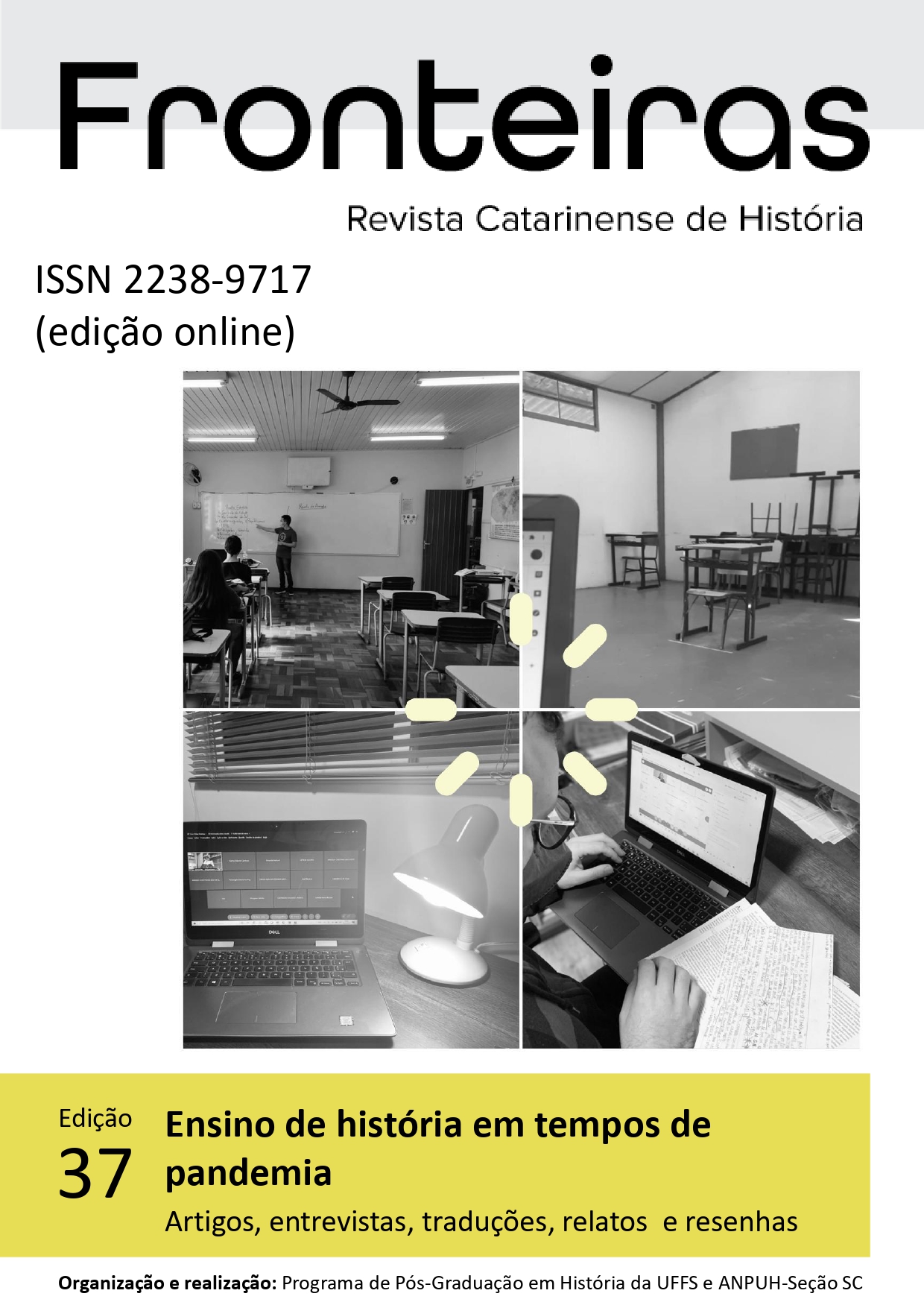
Horizons for the teaching of history in Latin America
DOI:
https://doi.org/10.36661/2238-9717.2021n37.12325Keywords:
Teaching of History, Digital humanities, Crisis, PublicsAbstract
The article discusses theoretical and thematic perspectives on the teaching of history in Latin America according to three topics: (1) the new identitarian constructions underlying the decolonial turn, (2) the digital humanities and (3) the relationship among historical knowledge, spaces of education (both material and immaterial) and the publics in network society. The pervasive effect of contents in network society has been shifting historical knowledge from its privileged spaces in modernity (school system) towards a diffuse system that is more prone to the circulatory effects of information, antagonisms and revisionisms. The current digitalization of society and its dynamics of teaching and research points to new modes of being and new contradictions within teaching activities, which are increasingly dependent on immaterial infrastructure and interactions. In an age of abrupt sociocultural and economic changes, the reflection on the horizons of the teaching of history also implies a broader framework concerning the diagnoses of the crisis of humanities.
Downloads
References
ABUD, Katia; SILVA, André Melo; ALVES, Ronaldo. Ensino de história. São Paulo: Cengage Learning, 2010.
AGAMBEN, Giorgio. Requiem per gli studenti. Instituto Italiano per gli Studi Filosofici, Roma, 22 maio 2020.
ANDINA, Tiziana. Truth, lies, and post-truth. In: CONDELLO, Angela. Post-truth, philosophy and law. Londres: Routledge, 2019.
ANHORN, Carmen Gabriel. Teoria da história, didática da história e narrativa: diálogos com Paul Ricoeur. Revista Brasileira de História, São Paulo, v. 32, 2012.
ARANTES, Paulo Eduardo. Formação e desconstrução: uma visita ao museu da ideologia francesa. São Paulo: Editora 34, 2021.
BALDACCI, Cristina. Archivi impossibili. Turim: Johan & Levi, 2016.
BENKLER, Yochai. The wealth of networks: how social production transforms markets and freedom. New Haven: Yale University Press, 2006.
BETTIG, Roland. Copyrighting culture: the political economy of intellectual property. Boulder: Westview Press, 1996.
BEYLIS, Guillermo; JAEF, Roberto; MORRIS, Michael; SEBASTIAN, Ashwini; SINHA, Rishabh. Efecto viral: covid-19 y la transformación acelerada del empleo en América Latina y el Caribe. Washington: Banco Mundial, 2020.
BITTENCOURT, Circe. Reflexões sobre o ensino de História. Estudos Avançados, São Paulo, v. 32, 2018.
BUFACCHI, Vittorio. Truth, lies and tweets: a consensus theory of post-truth. Philosophy & Social Criticism, Londres, v. 47, n. 3, 2020.
CAMERON, Duncan. The museum, a temple or the forum. Curator, v. 14, 1971.
CANAVESE, Mariana. Los usos de Foucault en Argentina. Buenos Aires: Siglo XXI, 2015.
CARDOSO, Oldimar. Para uma definição de didática da história. Revista Brasileira de História, São Paulo, v. 28, n. 55, 2008.
CASTRO-GÓMEZ; Santiago; GROSFOGUEL, Ramón. El giro decolonial: reflexiones para una diversidad epistémica más allá del capitalismo global. Bogotá: Siglo del Hombre Editores, 2007.
CARRETERO, Mario; MONTANERO, Manuel. Enseñanza y aprendizaje de la historia: aspectos cognitivos y culturales. Cultura y Educación, v. 20, 2008.
CAUVIN, Thomas. Public history. Londres: Routledge, 2016.
CEPAL. Estado de la banda ancha en América Latina y el Caribe. Santiago: ONU, 2018.
CRYMBLE, Adam. Technology and the historian: transformations in the digital age. Champaign: University of Illinois Press, 2021.
CURY, Marilia Xavier. Lições indígenas para a descolonização dos museus. Cadernos CIMEAC, Uberaba, v. 7, n. 1, 2017.
DILTHEY, Wilhelm. Einleitung in die Geisteswissenschaften: Versuch einer Grundlegung für das Studium der Gesellscahft und der Geschichte. Leipzig: Teubner, 1922. (Gesammelte Schriften I)
FAGUNDES, Gustavo Godoy. Livro didático, ensino de história e formação identitária nos anos iniciais do ensino fundamental. 102 f. Dissertação (Mestrado em Planejamento e Análise de Políticas Públicas) – Universidade Estadual Paulista “Júlio de Mesquita Filho”, Franca, 2020.
FANON, Frantz. Peau noire, masques blancs. Paris: Seuil, 1952.
FARIA, Rafael Emilio. Reprodução de paradigmas: o conceito de colonialidade para análise dos livros didáticos de história. Dissertação (Mestrado em Planejamento e Análise de Políticas Públicas) – Universidade Estadual Paulista “Júlio de Mesquita Filho”, Franca, 2021. (em preparação).
FLORESCANO, Enrique. El patrimonio nacional de México. Mexico, DF: Fondo de Cultura, 1997. (2 vols.)
FLORESCANO, Enrique. La historia debe formar al ciudadano y desarrollar sus habilidades para su aportación social. Actas, v. 3, 2006.
FONSECA, Sérgio César; NARITA, Felipe Ziotti. Conflito e cultura histórica. In: MARTINO, Vânia. Ensino de história I. Curitiba: CRV, 2018.
FONTAL MERILLAS, Olaia. Educación patrimonial: retospectiva y prospectivas para la próxima década. Estudios Pedagógicos, v. 42, 2016.
FONTANA, Josep. Qué historia enseñar?. Clio & Asociados, v. 7, 2004.
FOUCAULT, Michel. Qu’est-ce que la critique? Critique et Aufklärung (1978). Paris: Vrin, 2015.
GARCÍA VALECILLO, Zaida. Estrategias educativas para la valoración del patrimonio cultural en la educación básica en Venezuela. Educere, Bogotá, v. 11, 2007.
GIDDENS, Anthony. A vida em uma sociedade pós-tradicional. In: GIDDENS, Anthony; LASH, Scott; BECK, Ulrich. Modernização reflexiva. São Paulo: Editora Unesp, 2012.
GARCIA CANCLINI, Nestor. Ciudadanos reemplazados por algoritmos. Guadalajara: Universidad de Guadalajara, 2020.
GIORDANO, Verónica; RODRÍGUEZ, Gina Paola. Memorial struggles and power strategies of the rights in Latin America today. Universitas, Quito, v. 31, 2019.
GÓMEZ CARRASCO, Cosme; RODRÍGUEZ PÉREZ, Raimundo. La historia como materia formativa: reflexiones epistemologicas e historiográficas. Revista de Historiografía, v. 27, 2017.
GRANJA MATIAS, Simon. No volverá la cátedra de historia a los colegios. El Tiempo, Bogotá, 17 jan. 2018.
GRECO, Gian; FLORIDI, Luciano. The tragedy of the digital commons. Ethics and Information Technology, v. 6, n. 2, 2004.
HABERMAS, Jürgen. Strukturwandel der Öffentlichkeit. Frankfurt am Main: Suhrkamp, 1990.
HALL, Stuart. The question of cultural identity. In: HALL, Stuart; HALL, David; MCGREW, Tony. Modernity and its futures. Londres: Polity, 1992.
HEIDEGGER, Martin. Ontologie: Hermeneutik der Faktizität. Frankfurt am Main: Vittorio Klostermann, 1988. (Gesamtausgabe 63)
JAY, Paul. The humanities crisis and the future of literary studies. Nova York: Palgrave Macmillan, 2014.
KUDLÁCOVÁ, Blanka. History of education and historical-educational research in Slovakia through the lens of European context. Espacio, Tiempo y Educación, v. 3, 2016.
LE GOFF, Jacques. L’histoire nouvelle. In: LE GOFF, Jacques. La nouvelle histoire. Paris: Éditions Complexe, 2006.
LEGÊNE, Susan; AKKER, Chiel. Museums in a digital culture. Amsterdam: Amsterdam University Press, 2020.
LESSIG, Lawrence. Code and other laws of cyberspace. Nova York: Basic Books, 1999.
LOUKISSAS, Yanni. All data are local. Cambridge: MIT Press, 2019.
MALDONADO-TORRES, Nelson. Outline of ten theses on coloniality and decoloniality. Foundation Frantz Fanon, Paris, 26 out. 2016.
MANOEL, Ivan Aparecido. O ensino de história no Brasil: origens e significados. Cadernos CIMEAC, Uberaba, v. 1, n. 1, 2011.
MANOVICH, Lev. Cultural data: possibilities and limitations of the figital data universe. In: GRAU, Oliver; COONES, Wendy; RÜHSE, Viola (ed.). Museum and archive on the move: changing cultural institutions in the digital era. Berlin: Gruyter, 2017.
MAXWELL, W. David. The plight of the humanities. Journal of Aesthetic Education, v. 3, n. 2, 1969.
MCCULLOCH, George. History of education. In McCulloch, G.; Crook, D. (eds.). The Routledge International Encyclopedia of Education. Londres: Routledge, 2008.
MEMMI, Albert. Le racisme. Paris: Gallimard, 1982.
MENESES, Ulpiano. A problemática da identidade cultural nos museus. Anais do Museu Paulista, São Paulo, n. 1, 1993.
MESA MADRID, Miguel; ZÁPATA GIRALDO, Edwin. Entretejiendo prácticas decoloniales en la enseñanza de la historia. 140 f. Monografia (Licenciatura em Ciências Sociais) - Universidade de Antioquia, Medellín, 2017.
MESA Y LEOMPART, José. Compendio de la historia de América. Paris: Rosa y Bouret, 1870. (2 vols.)
MIGNOLO, Walter. Educación y decolonialidad: aprender a desaprender para poder re-aprender. Revista del IICE, v. 35, 2014.
MIGNOLO, Walter. Local histories, global designs: coloniality, subaltern knowledges, and border thinking. Princeton: Princeton University Press, 2010.
MORELOCK, Jeremiah; NARITA, Felipe Ziotti. The society of the selfie: social media and the crisis of liberal democracy. Londres: University of Westminster Press, 2021.
NARITA, Felipe Ziotti. Ainda aprender com a história?. In: FONSECA, Sérgio César; JESUS, Carlos Gustavo. Ensinar história: currículos, práticas e sujeitos. São Paulo: Millennium Books, 2021a.
NARITA, Felipe Ziotti. A educação da sociedade imperial. Curitiba: Appris, 2017.
NARITA, Felipe Ziotti. Between a double crisis. In: PIEKARSKA, Anna; JUSKOWIAK, Piotr; KRZESKI, Jakub; SZADKOWSKI, Krystian. Commoning: the common as a process of critique, struggle and change. Poznan: Praktyka Teoretyczna, 2020.
NARITA, Felipe Ziotti. Educação, vida urbana e moralidade: a elaboração do povo e a invenção do social no fim de século brasileiro. 378 f. Relatório (Pós-doutorado) – Universidade de São Paulo, Ribeirão Preto, 2019.
NARITA, Felipe Ziotti. Morale scolaire et transculturation dans l’espace atlantique au XIXe siècle. In: FONTAINE, Alexandre. Penser la circulation de savoirs sacolaires dans le monde transatlantique. Lormont: Le Bord de l’eau, 2021b.
NARITA, Felipe Ziotti. O século e o império: tempo, história e religião no segundo reinado. Curitiba: Appris, 2014.
NARITA, Felipe Ziotti. Para uma nova figuração da práxis: a teoria social e o princípio do comum. Pós Ciências Sociais, São Luís, v. 15, 2018a.
NARITA, Felipe Ziotti. Unlimited capitalism and the politics of the common. In: RATAJCZAK, Mikolaj; BLESZNOWSKI, Bartlomiej. Cooperation as the institution of the common. Poznan: Praktyka Teoretyczna, 2018b.
NARITA, Felipe Ziotti; KATO, Danilo Seithi. Construção democrática e educação popular: para um esquema interpretativo da América Latina. Cadernos CIMEAC, v. 10, n. 3, 2020.
NUSSBAUM, Marta. Not for profit: why democracy needs the humanities. Princeton: Princeton University Press, 2010.
PANDEL, Hans-Jürgen. Geschichtsdidaktik. Berlim: Wochenschau, 2017.
PANDEL, Hans-Jürgen. Geschichtskultur. In: MAYER, Ulrich (Org.) Wörterbuch Geschichtsdidaktik. Schwalbach: Wochenschau, 2006.
PÉREZ HERRERO, Pedro; GARCIA FERNÁNDEZ, Gonzalo. La importancia de la enseñanza de la historia para el futuro de los estudiantes. The Conversation, Nova York, 7 ago. 2019.
PERLOFF, Marjorie. Crisis in the humanities?. In: PERLOFF, Marjorie. Differentials: poetry, poetics, pedagogy. University of Alabama Press, 2004.
PETRAZZINI, Ben. Digital poverty: Latin American and Caribbean perspectives. Warwickshire: Intermediate Technology Publications, 2007.
PLÁ, Sebastián. La enseñanza de la historia como objeto de investigación. Secuencia, México DF, v. 84, 2012.
PLUMB, John. Crisis in the humanities. Baltimore: Penguin, 1964.
POMIAN, Krzysztof. Des saintes reliques à l’art moderne. Paris: Galliard, 2003.
PRIETO, Guillermo. Compendio de historia universal. Mexico: El Gran Libro, 1888.
RAMALLO, Francisco. Narrativas descoloniales, (re)escrituras de la historia y enseñanzas otras. Educación, Lenguaje y Sociedad, v. 14, 2017.
RESTREPO, Eduardo; ROJAS, Axel. Inflexión decolonial: fuentes, conceptos y cuestionamientos. Bogotá: Editorial Universidad del Cauca, 2010.
RHEINGOLD, Howard. The virtual community. Cambridge: MIT Press, 2000.
ROCA, Andrea. Acerca dos procesos de indigenização dos museus. Mana, Rio de Janeiro, v. 21, 2015.
ROSNAY, Mélanie; STALDER, Felix. Digital commons. Internet Policy Review, v. 9, n. 4, 2020.
RÜSEN, Jörn. Lebendige Geschichte. Göttingen: Vandenhoeck & Ruprecht, 1989.
SCHEINER, Livia. Formação histórica em alunos do ensino de jovens e adultos. In: NARITA, Felipe Ziotti; CUNHA, Marcus Vinicius; SILVA, Tatiane (Orgs.). Educação em perspectiva histórica. Franca: História e Cultura, Unesp, 2015.
SCHMIDT, Maria Auxiliadora; BARCA, Isabel; URBAN, Ana Claudia. Passados possíveis: a educação histórica em debate. Ijuí: Unijuí, 2014.
SCHNAPP, Jeffrey; PRESNER, Todd. Manifeste pour des humanités numériques 2.0. Multitudes, Paris, v. 59, 2015.
SHORTER, Edward. The historian and the computer. Nova York: Prentice Hall, 1971.
SIERRA, Justo. Compendio de historia de la antigüedad. México DF: UNAM, 1984 [1880]. (Obras completas, vol. 10)
SÖDERBERG, Johan. Copyleft vs. copyright. First Monday, Chicago, v. 7, n. 3, 2002.
SORJ, Bernardo; MARTUCCELLI, Danilo. O desafio latino-americano: coesão social e democracia. Rio de Janeiro: Civilização Brasileira, 2008.
SPIVAK, Gayatri. Can the subaltern speak?. In: WILLIAMS, Patrick. Colonial discourse and post-colonial theory. Heartfordshire: Harvester Wheatsheaf, 1994.
TERRANOVA, Tiziana. Network culture: politics for the information age. Londres: Polity Press, 2004.
TRIGO, Benigno. Foucault and Latin America. Londres: Routledge, 2002.
VARINE, Hugues. L’initiative communautaire. Paris: Éditions Mnes, 1991.
WRIGHT MILLS, Charles. The power elite. Oxford: Oxford University Press, 1999.